How to Start Forex Trading as a Beginner
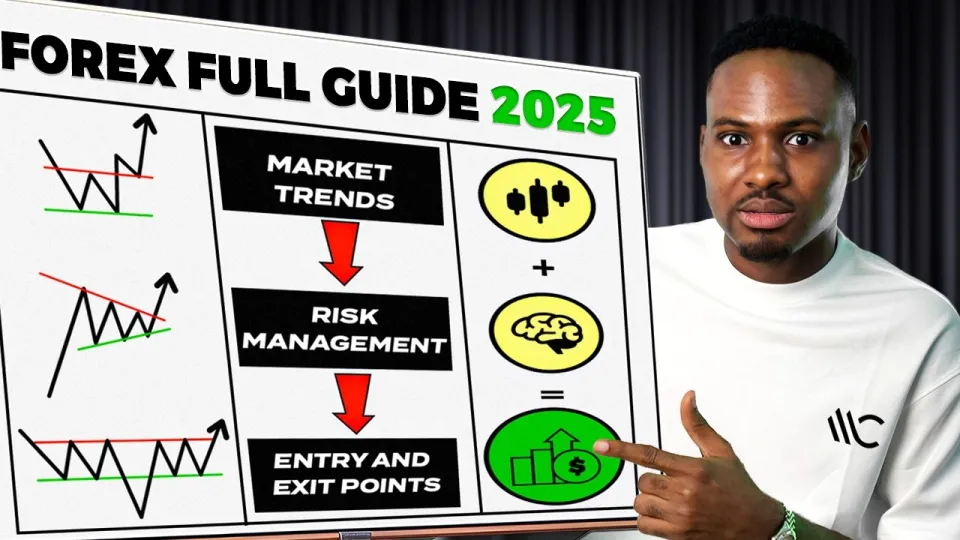
Video: How To Start Forex Trading For Beginners’ 2025 (Full Course)
Need articles like this for your video? They help promote it on YouTube and Google — order them in the Telegram bot @sat_sit_bot. The bot writes and publishes the articles itself (with your YouTube video embedded) on popular topical websites (no ads). Your first 50 articles are free.
Forex trading is the buying and selling of currency pairs on an over-the-counter market, and a beginner starts by learning how pairs are quoted, opening a demo account with a regulated broker, and risking no more than 1–2% of the account on a single trade. The full beginner course from Jeffrey Benson Forex walks through exactly that path, and the author points new students to the Fire Pips FX student plans for structured follow-up. Everything below stands on its own, with the video as a reference point rather than a script.
What forex trading actually is
Forex is a decentralised market where one currency is priced against another, and the price you see is the rate at which the base currency buys the quote currency. A quote of EUR/USD at 1.0850 means one euro costs 1.0850 US dollars. There is no central exchange: banks, brokers, funds and retail traders deal through a network of liquidity providers, which is why spreads and execution vary from broker to broker.
Currencies trade in pairs for a practical reason — you cannot value a currency in isolation. The major pairs (EUR/USD, GBP/USD, USD/JPY, USD/CHF, AUD/USD, USD/CAD, NZD/USD) carry the tightest spreads and the deepest order books, so they are the natural starting point. Exotic pairs such as USD/TRY or USD/ZAR look tempting because they move a lot, but the wider spreads and thinner liquidity punish beginners.
Two mechanics matter more than anything else at the start:
- Leverage lets you control a position larger than your deposit. At 1:100, $100 of margin controls $10,000 of currency. It amplifies losses exactly as fast as gains.
- Pips and lots define your profit and loss. One pip is the fourth decimal in most pairs (0.0001), and on a standard lot of 100,000 units it is worth roughly $10. A mini lot (10,000 units) makes a pip about $1, a micro lot $0.10.
How the forex market works across the trading day
The market runs 24 hours a day from Sunday evening to Friday evening, and the character of price action changes with each session. Sydney opens first, Tokyo follows, then London, then New York. The London session is the heaviest for EUR/USD and GBP pairs, and the London–New York overlap is where volatility and volume peak.
That structure has a practical consequence: a strategy tested only on quiet Asian hours will behave differently in the overlap. Beginners should pick one or two sessions, watch the same pairs in those hours for several weeks, and note how spreads widen around rollover and major news releases. High-impact data — central bank rate decisions, US non-farm payrolls, CPI prints — can move a major pair 50–100 pips in minutes, which is far beyond a beginner's stop distance.
Tools and setup every beginner needs
The minimum kit is small: a regulated broker, a trading platform, a demo account and a trading journal. The course recommends MetaTrader 5 as the platform and points to Assex Markets as the broker used in the walkthrough — https://my.assexmarkets.com/auth/register?partner_code=1699134 — but the checklist matters more than the name.
Broker checks before funding anything:
- Regulation by a recognised authority and client funds held in segregated accounts.
- Spreads on EUR/USD in the range of roughly 0.1–1.5 pips on a raw or standard account, depending on account type.
- Clear margin-call and stop-out rules, and a minimum deposit you can genuinely afford to lose.
- Reliable execution during news, plus mobile and desktop access.
Platform skills to learn on demo: placing market and pending orders, setting stop-loss and take-profit in pips, calculating lot size, and reading the spread and margin level. Demo trading is not a formality — it is where you make your mistakes for free. A common piece of advice in the comments under the course is to keep a notebook while watching tutorials, because writing down the four sessions and the risk rules is what makes them stick.
Building a basic strategy foundation
A workable beginner strategy is a set of rules for direction, entry, exit and size — not a prediction. Price action on higher timeframes is the usual starting point: trend direction on the daily chart, entries on the 4-hour or 1-hour chart. Two plain structures cover most of what a new trader needs:
- Trend continuation. Identify a clear sequence of higher highs and higher lows (or the reverse). Wait for a pullback into a zone of prior support or resistance, then enter in the direction of the trend with a stop beyond the swing point.
- Range trading. When price is trapped between a well-tested ceiling and floor, buy near the floor and sell near the ceiling with stops just outside the range — and stand aside once the range breaks.
Support and resistance, trendlines, moving averages and candlestick patterns are all just ways of describing where buyers and sellers previously acted. The edge comes from consistency: a defined setup, a fixed stop, and a target with at least a 1:1.5 to 1:2 risk-to-reward ratio so that a 40% win rate can still be profitable. Backtest the rules on historical charts before risking money, and write down the result.
Risk management and your first trade
Risk management is the part that decides whether a beginner survives, and the rule is simple: risk a fixed 1–2% of equity per trade. On a $1,000 account that is $10–$20 of risk, which at a 20-pip stop means a micro lot (about $0.10 per pip) or less. Position size is calculated from the stop distance, never chosen by feel.
Steps for a first live trade after demo practice:
- Pick one major pair, such as EUR/USD, and one session.
- Define the setup in writing, including entry trigger, stop and target.
- Calculate lot size from the 1–2% risk cap and the stop distance in pips.
- Place the order with stop-loss and take-profit attached at the same time.
- Log the trade — reason, result, screenshot — and review the log weekly.
Avoid the classic beginner errors: no stop-loss, moving the stop further away to avoid being wrong, revenge trading after a loss, over-leveraging on a small account, and trading during major news with a stop that sits inside the noise.
Common beginner questions answered
Most doubts from new traders fall into a few repeating themes. The first is capital: a few hundred dollars is enough to learn on a micro account, but not enough to live on, so treat early profits as proof of process rather than income. The second is time: an hour or two a day on one session is sufficient for swing and intraday approaches; screen-watching all day adds fatigue, not edge.
The third theme is trust in the material itself. Viewers of the course repeatedly note that it explains concepts without assuming prior knowledge, and that the risk-management section is where many finally understand position sizing. The honest caveat is that no course, signal group or mentor removes the need for screen time — copying trades can teach order placement, but it does not build the judgment to manage a position when the market moves against you.
Useful links
- Student plans and course access: https://firepipsfx.com/plans
- Free daily signal channel: https://t.me/firepipsignals
- Broker registration used in the walkthrough: https://my.assexmarkets.com/auth/register?partner_code=1699134
- Premium signal group subscription bot: https://t.me/jeffreybenzhelpbot
Final takeaway
Forex trading rewards a boring, repeatable process: understand how pairs and leverage work, practise on demo until order placement is automatic, trade one setup on one pair, and cap risk at 1–2% per trade. The beginner course from the Jeffrey Benson Forex channel is a useful spine for that process because it moves from market mechanics to tools, strategy and risk in one sequence. Start with a demo account, keep a written journal, and only scale up after a documented stretch of disciplined trades. If you want the structured route, begin with the Fire Pips FX plans and treat every signal as a lesson, not a shortcut.
Key takeaways
- Forex is an over-the-counter market where currencies are quoted in pairs; the EUR/USD is the most liquid example.
- Four sessions — Sydney, Tokyo, London and New York — overlap and create the deepest liquidity, especially London–New York.
- A standard lot is 100,000 units; one pip on EUR/USD equals about $10 per standard lot, $1 per mini lot.
- Beginners need three tools: a regulated broker, MetaTrader 5 or similar, and a demo account for practice.
- Risk per trade should stay at 1–2% of account equity, which keeps a losing streak survivable.
Questions & answers
How much money do I need to start forex trading?
You can start learning with a demo account at zero cost. For live trading, a few hundred dollars on a micro-lot account is enough to practise real execution while keeping risk at 1–2% per trade. Larger deposits are not a substitute for a tested process.
Can I copy another trader's signals instead of learning?
Copying trades teaches order placement and shows how a setup looks in real time, but it does not build the judgment to manage risk when a position moves against you. Most educators suggest using signals alongside your own demo practice rather than instead of it.
How long does it take to become consistently profitable?
There is no fixed timeline, but a realistic path is several months of demo trading and journaling before going live, then a further stretch of small-size trading. Consistency comes from a defined setup and fixed risk, not from the number of hours spent watching charts.
Which currency pair is best for a beginner?
Major pairs such as EUR/USD offer the tightest spreads and deepest liquidity, which makes them the most forgiving place to learn. Exotic pairs move more but carry wider spreads and thinner liquidity that punish inexperience.
Source: How To Start Forex Trading For Beginners’ 2025 (Full Course) · Markdown version